
- Home
- The Independent Living Movement Around the World
The Independent Living Movement Around the World
From Berkeley in 1972 to the UN Convention on the Rights of Persons with Disabilities.
Brief timeline
- 1960s
The IL movement takes shape in the United States, amid the civil rights movement.
- 1962
Ed Roberts enters the University of California, Berkeley.
- March 1972
The first Center for Independent Living (CIL) is founded in Berkeley.
- 1973 and 1977
Section 504 of the Rehabilitation Act prohibits discrimination; the 1977 sit-ins push for its real enforcement.
- 1986
Human Care Association, Japan’s first IL center, in Hachioji, Tokyo.
- 1987
STIL in Stockholm, Sweden, starts a personal assistance pilot project.
- 1989
ENIL is founded at the European Parliament in Strasbourg.
- 1990
The United States passes the Americans with Disabilities Act (ADA).
- 1994
Sweden establishes a national right and funding system for personal assistance.
- 2006 / 2008
The United Nations adopts the Convention on the Rights of Persons with Disabilities (CRPD), which enters into force.
1. The beginning: from university life to claiming rights
The Independent Living Movement (IL Movement) took shape in the United States in the 1960s, in a climate of civil rights activism, opposition to discrimination, and demands that excluded groups have the right to decide their own lives. It was inspired by the African American struggle for equality and other social movements, but developed into a set of ideas and a movement grounded in the experiences and demands of disabled people themselves.[1][2]
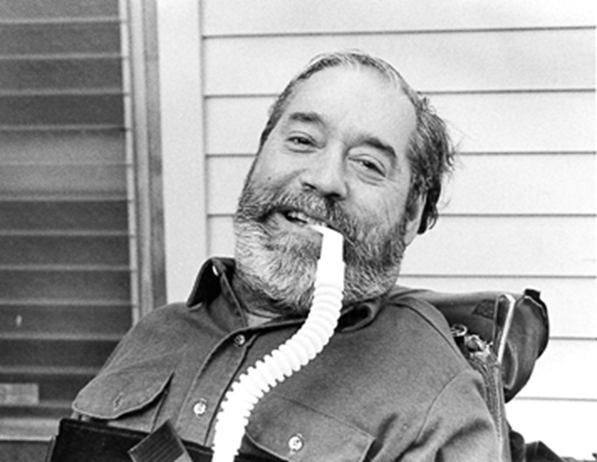
Photo: Minnesota Council on Disability, “Why Remembering Ed Roberts’ Advocacy Is Crucial Today” (22 January 2025)
One key figure was Ed Roberts, who was disabled by polio, had a severe physical disability and used a respirator. He entered the University of California, Berkeley in 1962. His admission, and that of other disabled students, led to the development of support systems at the university, including housing, help with daily living and support to access study. These experiences also showed the limits of services tied to a particular place or system, which did not guarantee disabled people equal choices about how to live outside the university.[1][3]
Disabled students at Berkeley began to organize, share experiences and challenge rules that limited their participation. They showed that the difficulties of daily life came not only from physical conditions, but also from inaccessible environments, a lack of support services, and other people making decisions for them. Their university experience gradually grew into a broader demand: disabled people should control their own lives and their own support services.
2. 1972: the first Center for Independent Living
In March 1972, disabled activists and community members founded the Center for Independent Living (CIL) in Berkeley, California. It grew out of a support program for disabled students at the university and the work of activists such as Ed Roberts, Hale Zukas, John Hessler and Jan McEwen Brown. The CIL was not the creation of one person, but the result of disabled people and allies working together.[1][3]
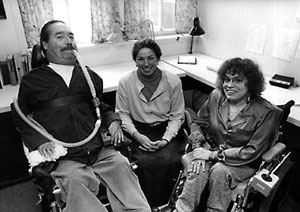
Photo: Andrew Ritchie, Berkeleyan, UC Berkeley, “Bancroft archive documents disability rights movement” (29 November 2000)
The core idea of the CIL was that disabled people know their own needs best, and should lead the design, management and evaluation of the services that affect their lives. The center provided many services, such as information and counseling, help finding accessible housing, support for living in the community, skills training and advocacy, while pushing for changes in the environment and in public policy.
3. From community services to changes in law
The disability movement in the United States did not stop at setting up service centers. It was linked to the civil rights struggle and to concrete changes in law. In 1973 the United States passed the Rehabilitation Act, an important rehabilitation law whose Section 504 prohibits discrimination on the basis of disability in programs or activities receiving federal financial assistance. Protests and sit-ins by activists in 1977 played a key role in pushing the government to enforce Section 504 in earnest.[1][4]
Later, the Americans with Disabilities Act (ADA) was passed in 1990, a civil rights law covering disability discrimination in many areas, such as employment, state and local government services, and access to public places and certain services. The ADA is not the same law as the Rehabilitation Act, nor simply a law funding CILs; it is part of the development of rights that the disability movement pushed for together.[1][4]
On the conceptual side, Gerben DeJong, a social and policy researcher, helped develop and spread the IL framework by comparing the Independent Living approach with a rehabilitation approach centered on professionals. The key point of the IL approach is that support should increase disabled people’s choice and control over their lives, not decide their lives for them.[5]
4. Spreading to Europe: rights, community living and personal assistance
From the late 1970s through the 1980s, the IL idea spread to European countries through exchanges of experience, study visits and the organizing of disabled activists. The movement challenged approaches that kept disabled people mainly in institutions or group housing, and offered the alternative of living in one’s own home and community with support based on one’s needs.[2][6]
In Sweden, Adolf Ratzka and other disabled activists promoted personal assistance in which users have the power to choose and direct their own assistants. The Stockholm Cooperative for Independent Living (STIL) began a pilot project in 1987 and influenced later policy change. Sweden’s reform, which took effect in 1994, created a national right and funding system for personal assistance, with entitlement depending on legal conditions.[2]
In the United Kingdom, Project 81, which involved disabled people trying to leave institutions to live in the community, is one of the key examples of the Independent Living movement. CILs in the UK began to develop in the 1980s, focusing on services, mutual support and social change.[6][7]
In April 1989, a conference on personal assistance at the European Parliament in Strasbourg led to the founding of the European Network on Independent Living (ENIL). The network promotes Independent Living, non-discrimination, peer support and an end to the segregation of disabled people from the community.[7][8]
5. Japan: learning across countries and adapting to local context
Japan is an important example of taking the IL idea from the United States and developing it in its own context. Exchanges between Japanese and American activists increased in the early 1980s. Ed Roberts and Judy Heumann helped spread the idea, while Japanese activists travelled to learn both the philosophy and how to run a center.[9][10]

Photo: Thailand Council for Independent Living (TIL)
Human Care Association was founded in Hachioji, Tokyo, in June 1986 and is recognized as Japan’s first Center for Independent Living. It developed services such as personal assistants, counseling, Independent Living skills training and sharing of knowledge, with disabled people as both service users and operators. The growth of IL centers in Japan shows that applying an international idea requires adapting it to each country’s service system, communities and social conditions.[9][10]
6. From a social movement to a global human rights framework
As the IL idea spread to many regions, its importance was not only in having service centers, but in affirming that disabled people have the right to choose where to live, choose their assistants, choose their education and work, and take part in community life on an equal basis. Good support must help disabled people set their own goals and decide how to live.
These principles are closely aligned with the UN Convention on the Rights of Persons with Disabilities (CRPD), adopted in 2006 and in force since 2008, especially Article 19 on the right to live independently and be included in the community. IL was not the only cause of the CRPD, but the IL movement was one of the important movements and sources of ideas that pushed the shift towards a human rights approach and the participation of disabled people.[2][11]
7. Key lessons from the history of IL
- Disabled people must have the power to decide on and control the services that affect their lives, not be mere recipients.
- Help with daily living, such as Personal Assistance (PA), is a tool for disabled people to determine their own lives, not a reason for others to control their lives.
- IL centers provide direct services, mutual support, and advocacy for structural change.
- Independence does not mean doing everything yourself or not depending on anyone, but having choice, control and decision-making over your own life.
- The history of IL is a collective movement of many disabled people. Honoring key individuals should go together with recognizing the role of groups and networks.
- Applying IL in each country must take into account its laws, welfare system, culture and the needs of local disabled people.
Number of IL centers in different countries (approximate)
| Country | Number of IL centers |
|---|---|
| United States | 403 |
| Canada | 23 |
| Japan | 109 |
| South Korea | 245 |
| Taiwan | 3 |
| Pakistan | at least 6 |
| Nepal | at least 1 |
| Cambodia | at least 1 |
| Mongolia | at least 1 |
References
- Center for Independent Living. “Our History.” thecil.org
- Independent Living Institute. “The Independent Living movement paved the way: Origins of personal assistance in Sweden.” independentliving.org
- Zukas, H. “The History of the Berkeley Center for Independent Living (CIL).” Independent Living Institute, 1975. independentliving.org
- U.S. Department of Justice. “A Guide to Disability Rights Laws” / ADA background resources. ada.gov
- DeJong, Gerben. “The Movement for Independent Living: Origins, Ideology and Implications for Disability Research.”
- “Prefiguration and the independent living movement.” Social Movement Studies, 2026. tandfonline.com
- European Network on Independent Living (ENIL). “Independent Living.” enil.eu
- ENIL. “The Strasbourg Resolutions.” Independent Living Institute archive. independentliving.org
- JICA. “Brief Chronology of Independent Living Movements,” seminar materials by Shoji Nakanishi. openjicareport.jica.go.jp
- JICA Partner. “Human Care Association.” partner.jica.go.jp
- United Nations. “Convention on the Rights of Persons with Disabilities,” Article 19. ohchr.org